
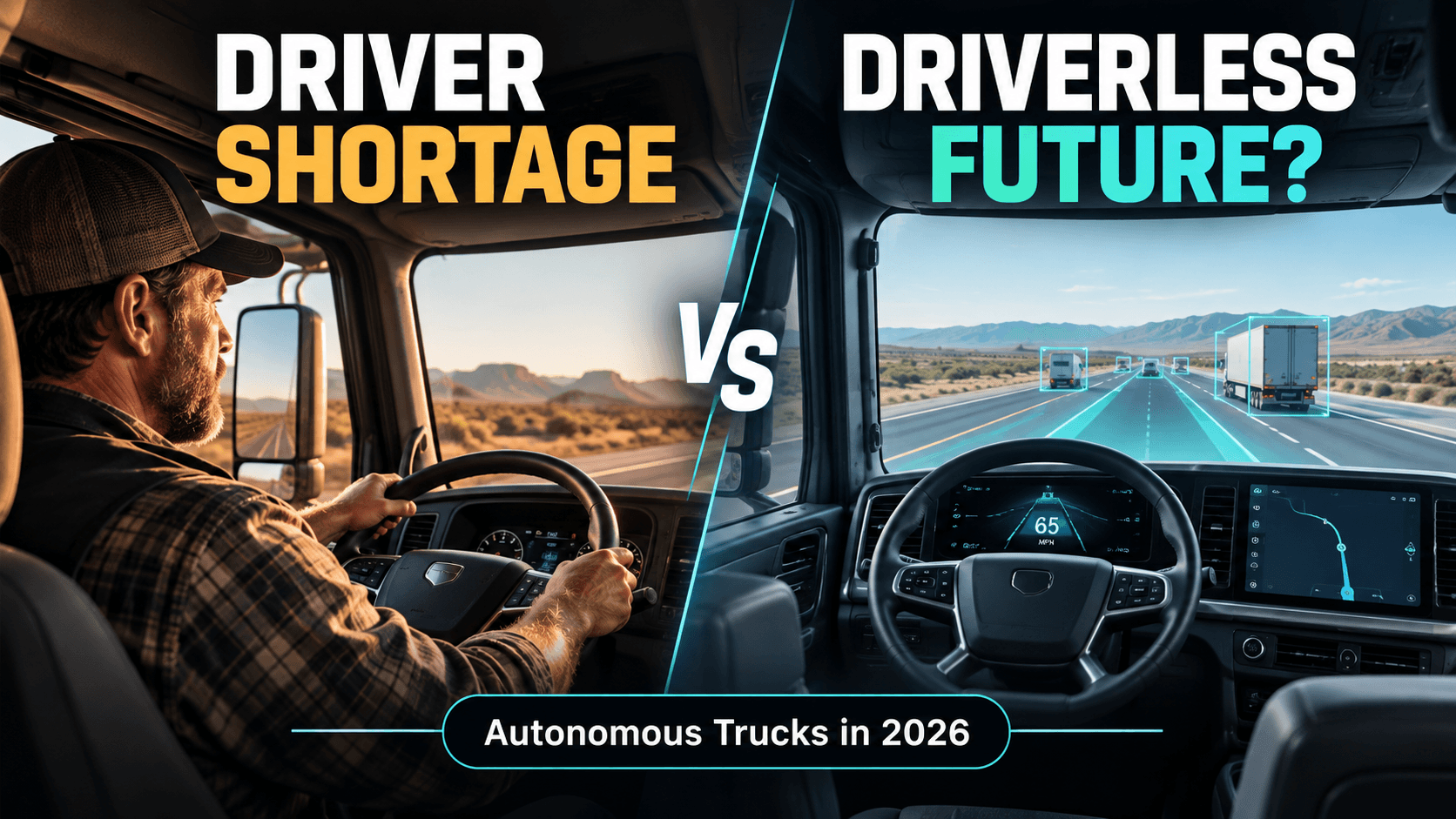
Driver Shortage or Driverless Future? Autonomous Trucks in 2026
Are autonomous trucks the answer to America's driver shortage? Explore Tesla and Aurora's plans, FMCSA regulations, and growing concerns about driverless trucking.
Key dates
- Aurora announces its 2030 expansion visionSeptember 23, 2026
- Overdrive publishes driver shortage analysisOctober 20, 2026
- Aurora's target to reach 200 driverless trucksDecember 31, 2026
- Aurora's target to exceed 30,000 driverless trucksDecember 31, 2030
The U.S. trucking industry is once again debating a familiar issue: the truck driver shortage. But in 2026, a growing number of companies are promoting a different solution: autonomous trucks that can operate without a human driver behind the wheel.
Companies including Tesla and Aurora are accelerating their plans for driverless trucking, while federal regulators are considering how existing safety requirements should adapt to autonomous vehicle technology.
The debate raises an important question: Will self-driving trucks solve the driver shortage, or eventually replace human truck drivers?
Is There Really a Truck Driver Shortage in 2026?
The trucking industry has debated driver availability for years.
Large motor carriers frequently cite difficulties recruiting qualified drivers, while critics argue that wages, working conditions, driver retention, and truck parking shortages are major factors behind hiring problems.
The American Transportation Research Institute's (ATRI) 2026 Top Industry Issues report ranked the driver shortage as the fifth-biggest concern across the trucking industry.
For motor carriers specifically, the shortage ranked third.
However, the industry's renewed focus on driver availability comes at a time when autonomous trucking companies are preparing to expand commercial operations.
Tesla Semi: Elon Musk Sees Autonomous Trucks as a Solution
Tesla CEO Elon Musk has argued that self-driving semi-trucks could help address what he describes as a serious shortage of truck drivers in the United States.
Tesla has discussed introducing autonomous capabilities to its electric Semi, with late 2026 or early 2027 identified as potential targets.
The company sees autonomous technology as an opportunity to increase freight transportation capacity while reducing reliance on human drivers for certain routes.
However, Tesla's autonomous Semi plans remain forward-looking, and the proposed timeline should not be interpreted as confirmation of widespread driverless operations.
Aurora Plans to Scale to 30,000 Driverless Trucks by 2030
Aurora Innovation is among the companies making significant progress toward commercial autonomous trucking.
Its driverless trucks are already operating on selected freight routes in Texas.
In September 2026, Aurora outlined an ambitious expansion strategy:
200 driverless trucks targeted by the end of 2026.
More than 1,000 driverless trucks targeted by the end of 2027.
More than 30,000 driverless trucks targeted by 2030.
These figures represent company targets, not trucks already operating today.
Aurora's long-term strategy focuses on scaling its autonomous driving technology through partnerships with vehicle manufacturers and trucking fleets.
Major Companies Are Exploring Autonomous Freight Transportation
Interest in driverless trucking extends beyond technology developers.
Companies including Amazon, Pepsi, and Walmart have been associated with autonomous freight pilot programs and technology partnerships.
For major retailers and logistics operators, potential advantages include improved vehicle utilization, greater scheduling flexibility, and reduced dependence on driver availability for selected freight lanes.
However, most autonomous trucking operations remain limited to specific routes, operating conditions, and commercial arrangements.
USDOT and FMCSA Prepare for Driverless Trucking
Federal regulators are also evaluating how autonomous commercial vehicles fit within existing transportation safety rules.
In 2026, the U.S. Department of Transportation outlined initiatives involving automated vehicle standards and regulatory modernization.
One area of discussion involves traditional equipment requirements originally designed for human-operated vehicles.
Federal regulators have also addressed requests involving alternative warning devices for autonomous trucks, including cab-mounted warning beacons in place of conventional roadside warning triangles.
These developments could support broader deployment of driverless freight operations.
However, regulatory accommodations do not mean that autonomous trucks have unrestricted approval to operate anywhere in the United States.
Autonomous Trucks Are a Growing Concern for Company Drivers
The potential impact on trucking employment is becoming a more prominent industry issue.
According to ATRI's 2026 survey, autonomous trucks ranked as the third-biggest concern among company drivers.
The issue did not rank among the five leading concerns for owner-operators.
This difference suggests that concerns about autonomous technology vary across different groups of trucking professionals.
Some drivers worry about future job displacement, while supporters argue that autonomous trucking could help address capacity constraints and complement existing freight operations.
Will Autonomous Trucks Replace Human Truck Drivers?
Despite advances in driverless technology, widespread replacement of human truck drivers is far from certain.
Autonomous systems currently face operational limitations involving complex delivery locations, unusual road conditions, adverse weather, and certain urban environments.
Human drivers also perform tasks beyond highway driving, including equipment inspections, load securement, customer communication, and handling unexpected delivery situations.
As autonomous technology develops, some long-haul highway operations could become increasingly automated, while other trucking jobs may continue to require human involvement.
The Future of Trucking: Driver Shortage or Driverless Industry?
The renewed debate over the truck driver shortage is taking place alongside rapid investment in autonomous freight transportation.
Tesla and Aurora see major opportunities in driverless trucking, and regulators are evaluating ways to accommodate the technology.
At the same time, many drivers remain concerned about what automation could mean for employment, wages, and the future of the profession.
The central question is whether autonomous trucks will complement human drivers or gradually replace them on major freight routes.
What do you think? Will self-driving trucks solve the driver shortage, or will they create a new challenge for professional drivers?
Sources:
Frequently asked
Will autonomous trucks replace truck drivers?
Autonomous trucks could automate some long-haul highway operations, but widespread replacement of human drivers is not guaranteed. Many trucking tasks still require human involvement.
How many autonomous trucks does Aurora have in 2026?
Aurora is targeting 200 driverless trucks in operation by the end of 2026, with a longer-term goal of more than 30,000 by 2030. These are projected fleet sizes, not confirmed current totals.
Is Tesla developing a self-driving Semi truck?
Yes. Tesla has discussed plans to introduce autonomous capabilities to its electric Semi, with late 2026 or early 2027 identified as potential targets. Widespread commercial deployment is not yet confirmed.
Are autonomous trucks legal in the United States?
Autonomous truck operations are permitted under applicable federal and state requirements, but operating conditions and restrictions vary by jurisdiction. Federal regulators continue to evaluate autonomous vehicle safety rules.
Is there a truck driver shortage in 2026?
Driver availability remains a concern for many motor carriers, although the causes and extent of the shortage are debated. ATRI ranked the driver shortage fifth among overall trucking industry concerns in 2026.
Need help staying compliant?
Our safety team handles DOT compliance, audits and back office for carriers across 48 states.